I spent my first year at Berkeley with Professor Paul McEuen demonstrating that an electrolyte can efficiently gate a single-walled carbon carbon nanotube transister (pdf). Before going to Berkeley I was at MIT, where I wrote my undergraduate thesis with Professor Wolfgang Ketterle studying Bose-Einstein Condensation (BEC).
Summary of Experimental Work
Measurements of force and extension on single molecules of DNA have allowed for direct measurement of the molecule's mechanical properties, provided rigorous tests of theories of polymer elasticity, and established an experimental and conceptual framework for mechanical assays of enzymes that act on DNA. In my graduate research I have worked to develop and apply a novel assay to study the torque and twist in a single molecule of DNA.
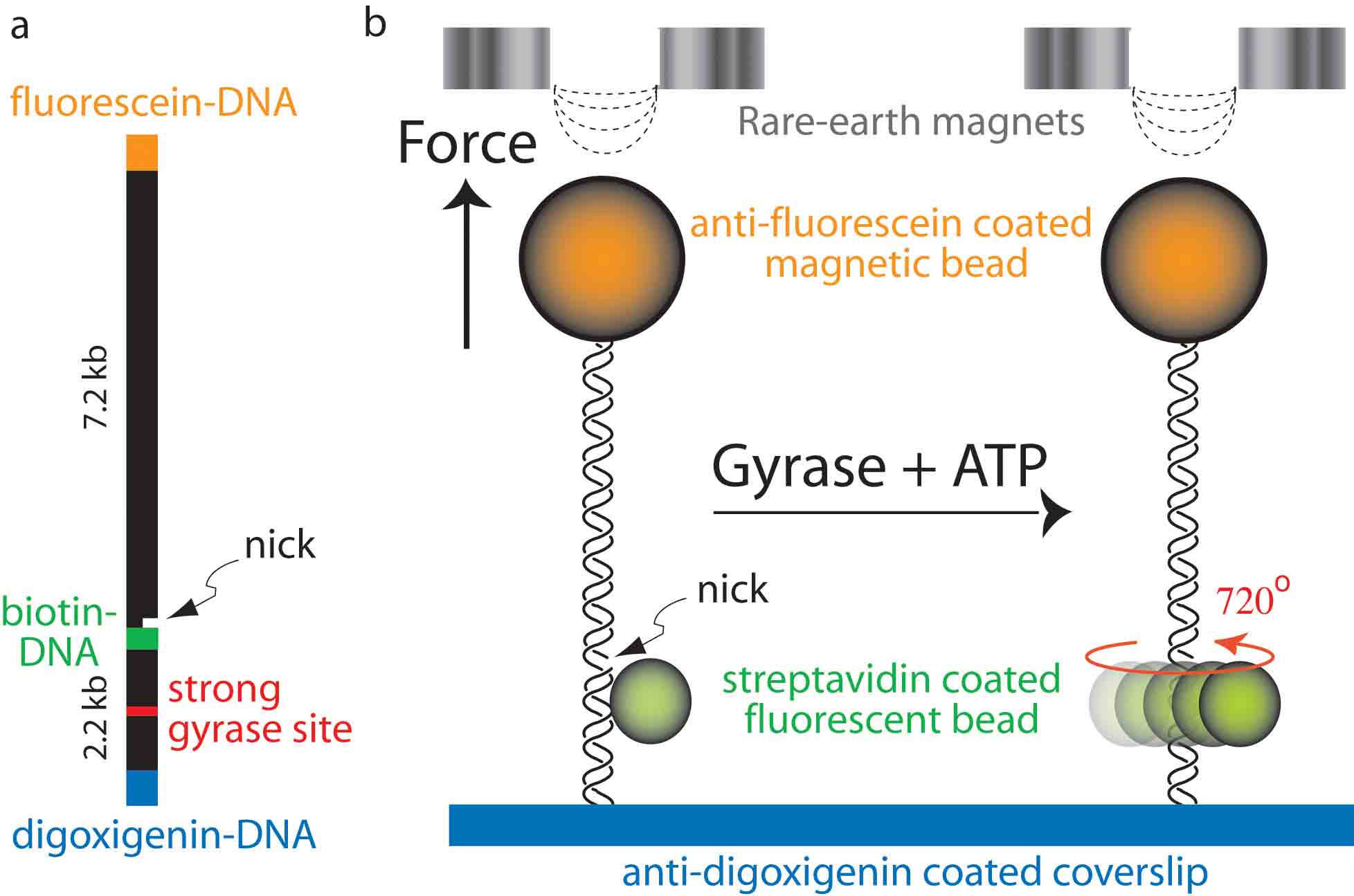
The technique involves the attachment of a small "rotor" bead to the side of a stretched DNA molecule, just below a single-stand nick. This nick acts as a free swivel, thus allowing the rotor bead to spin in response to torque in the lower DNA segment (see image below). Zev Brant and Michael Stone (joint with the Cozzarelli lab) took the lead in developing the assay. In this first paper demonstrating the Rotor Bead Tracking (RBT) assay, we measured the torque necessary to twisting DNA by a given angle. This allowed us to measure the torsional rigidity of DNA and also the torque necessary to induce structural transitions in DNA (pdf).
The RBT technique was originally developed in the laser tweezers, but since then I have worked to transfer the technique to the magnetic tweezers and apply it to a variety of other systems. By observing the magnitude of angular fluctuations of this rotor bead we have measured the torsional rigidity of DNA, and find a value ~ 50% higher than the value accepted from bulk experiments, but in good agreement with the value we measured previously by directly measuring the torque.
DNA is often modeled as an isotropic rod, but its chiral structure suggests the possible importance of anisotropic mechanical properties, including coupling between twisting and stretching degrees of freedom. Simple physical intuition predicts that DNA should unwind under tension, as it is pulled towards a denatured structure. We used rotor bead tracking to directly measure twist-stretch coupling in single DNA molecules. For small distortions, we find that, contrary to intuition, DNA overwinds under tension, reaching a maximum twist at a tension of ~ 30 pN. As tension is increased above this critical value, the DNA begins to unwind. The observed twist-stretch coupling predicts that DNA should also lengthen when overwound under constant tension, an effect that we quantitatively confirm. We present a simple model of DNA that explains these unusual mechanical properties of the double helix, and also suggests a possible origin for the anomalously large torsional rigidity of DNA. Twist-stretch coupling has important implications for site recognition by DNA-binding proteins (pdf of our paper DNA overwinds when streched).
Finally, we used the rotor bead technique to study the mechanochemical cycle of DNA gyrase, the molecular machine that is responsible for introducing essential negative supercoils into the bacterial genome. In the presence of gyrase and ATP, we observe bursts of rotation of the rotor bead corresponding to the processive, stepwise introduction of negative supercoils in strict multiples of two. Changes in DNA tension have no detectable effect on supercoiling velocity, but the enzyme becomes markedly less processive as the tension is increased by only a few tenths of picoNewtons. In a high resolution variant of our assay, we directly detect rotational pauses corresonding to two kinetic substeps: an ATP-independent step at the end of the reaction cycle and an ATP-binding step in the middle of the cycle, subsequent to DNA wrapping (pdf). We have since used a "classic" magnetic tweezers assay to study the effect of torque and DNA geometry on the function of DNA gyrase (pdf).
Figure: (a) DNA construct and (b) experimental design for the rotor bead technique, as applied to the study of DNA gyrase.
Theoretical Work
I have also been doing some work in nonequilibrium statistical mechanics. In particular, Chris Jarzynski proved that it is possible to recover equilibrium free energy differences by looking at a set of work values obtained arbitrarily far from equilibrium. This is a beautiful result, but it remains to be seen how useful the equality will be in experimental determinations of free energy differences. To aid in this, I explored the bias error and error of the Jarzynski free energy estimator (pdf). PNAS also commissioned a commentary, which is a nice introduction to the subject with a slightly different viewpoint.
I have also done data analysis, model building, and theory for the FtsK project, which is a collaboration between the Bustamante and Cozzarelli labs (see papers below).
Publications
Marcelo Nollmann, Michael D. Stone, Zev Bryant, Jeff Gore, Seok-cheol Hong, Nancy J. Crisona,Sylvain Mitelheiser, Anthony Maxwell, Carlos Bustamante, and Nicholas Cozzarelli
Nature Structural and Molecular Biology 14, 264 - 271 (2007)
Jeff Gore, Zev Bryant, Marcelo Nollmann, Mai U. Le, Nicholas R. Cozzarelli, and Carlos Bustamante
Nature 442, 836 - 839 (2006)
Jeff Gore, Zev Bryant, Michael D. Stone, Marcelo Nollmann, Nicholas R. Cozzarelli, and Carlos Bustamante
Nature 439, 100 - 104 (2006)
Oren Levy, Jerod L. Ptacin, Paul J. Pease, Jeff Gore, Michael B. Eisen, Carlos Bustamante, and Nicholas R. Cozzarelli.
Proc. Natl. Acad. Sci. 102, 17618 - 17623 (2005)
Paul J. Pease, Oren Levy, Gregory J. Cost, Jeff Gore, Jerod L. Ptacin, David Sherratt, Carlos Bustamante, and Nicholas R. Cozzarelli.
Science 307, 586 - 590 (2005)
 Angela K Eggleston. News & Views on the FtsK paper above.
Nature Structural and Molecular Biology 12, 216 (2005)
Jeff Gore, Felix Ritort, and Carlos Bustamante.
Proc. Natl. Acad. Sci. 100, 12564 (2003)
Ronald F. Fox. PNAS Commentary on the paper above:
PNAS 100, 12537 (2003).
Zev Bryant, Michael D. Stone, Jeff Gore, Steven B. Smith, Nicholas R. Cozzarelli, Carlos Bustamante.
Nature 424, 338 (2003)
Sami Rosenblatt, Yubal Yaish, Jiwoong Park, Jeff Gore, Vera Sazonova, and Paul McEuen.
Nano Letters. 2, 8 (2002)
M.D. Price, S.S. Somaroo, C.H. Tseng, J.C. Gore, A.F. Fahmy, T.R. Havel, and D.G. Cory.
Journal of Magnetic Resonance. 140: 371 - 378 (1999)